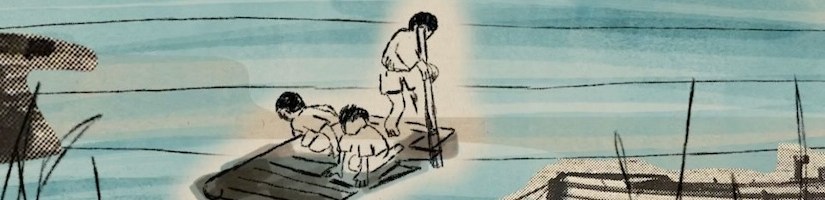
In the early hours of the morning of 1 February 1953, strong winds and a swelling tide caused the sea to rise to treacherous levels across the East Coast of England, sweeping away Creekmouth Village and setting in motion a history greater than one devastating night. Oral histories collected from former residents of Creekmouth shape the narrative of Djédjé-Fisher-Azoumé’s animation, which begins by capturing the character of daily life in the village. On happier days, children built rafts and paddled through the water traffic on a busy river; and in darker times, families huddled together in underground bomb shelters in the World War II blitz. The work follows the story of the Creekmouth Village residents through the night of the flood, the aftermath in the days that followed, all the way through to the difficulty of building new lives, homes and communities in a changing world. The present day site of Creekmouth, home to Barking Creek Flood Barrier, is vastly different to that of 1953.
Create London has worked in close collaboration with Creekmouth Preservation Society to ensure that the history of the village is maintained for future generations by collecting precious oral histories from the elders of Creekmouth Village. The animation carefully stitches these together with hand-drawn works, archival materials and photographs from mudlarking expeditions on the banks of the River Thames to create a visceral sense of life on the river; one that is at the core of Creekmouth’s former residents’ retellings. The oral history recordings and transcripts have been preserved in perpetuity at Valence House Archives and are available for public access.
The forgotten history of Creekmouth
The village of Creekmouth was built by John Bennett Lawes in the 1850s, as homes for workers at the nearby Lawes Chemical Factory. The birthplace of the artificial fertiliser industry, the chemical plant and Creekmouth Village are intertwined with histories of pollution and ecological damage in Barking. Lawes Chemical Factory produced superphosphates that can devastate non-human life in the soil, and in excess can run off into our water systems to further impact the environment. The fumes of sulphur shimmered in the air above Lawes’ tanks and devastated insect populations. This ecological harm is part of a lineage that continues to impact Barking & Dagenham – from the dumping of fuel ash which still permeates the soil, to the combined sewer overflows that routes industry waste into the Thames. Breaking Waves, a year-long project led by Create London, explores the uncomfortable relationship between climate change and industrial heritage in Barking & Dagenham.
Create London would like to thank Creekmouth Preservation Society, and elders Charlie, Maria, Avril, Joyce, John, Shirley and Jane; Dr Anna Maguire and Geneva Virasami from UCL East Public History; community interviewers Ryan, Ella and Anika; and Karen Rushton and Leeanne Westwood from Valence House Museum and Archive.
Commissioned by Create London as part of Breaking Waves. Made possible with funding from The National Lottery Heritage Fund.
Commission curated by Kieran Swann.
 KIERAN SWANN